
Survival of the...moderates?
 Almost 155 years ago, Charles Darwin changed how we as a
species view ourselves, the other
species around and before us and how we are related to them. With the
publication of ‘The Origin of Species’ evolution was
brought to the attention of the masses.
Almost 155 years ago, Charles Darwin changed how we as a
species view ourselves, the other
species around and before us and how we are related to them. With the
publication of ‘The Origin of Species’ evolution was
brought to the attention of the masses.We now know that, along with positive pressures for evolutionary change, there are also negative pressures. These pressures to change and adapt to an organism's environment force a species down one evolutionary path or another. We have learned the dogma that is ‘survival of the fittest’ but does our everyday perception of ‘fittest’ align with what Darwin first postulated? Is it the strongest organism, or the one that is best adapted?
Allow me to illustrate the point using the situation
regarding cholera infection and Cystic Fibrosis, a congenital, genetic disease
affecting the lungs and digestive system.
Vibrio cholera's mode of
pathogenesis is to inhibit correct water control across ion gated channels
including one known as CFTR. Cholera infection leads to loss of control of this
channel, which in turn leads to excessive water loss and, eventually, death if the fluids cannot be replaced in time. So what does this water borne
pathogen have to do with a disease like CF?
 |
| Vibrio cholerae with a Leifson flagella stain (digitally colorized) |
In Western Europe, Cystic Fibrosis incidence is much higher
than other regions of the world, particularly in Ireland, where it is the most
common genetically inherited disease. The presence of the alleles that confer
CF in a person also mean that the individual has significantly less or is
lacking in CFTR ion channels, the channels affected by cholera.
Therefore, there is a hypothesis that Cystic Fibrosis
carriers, who are heterozygous for the mutated disease, exhibit no pathological
symptoms but still encode for a reduced level of CFTR ion channels. This would
have allowed them greater resistance to cholera pathogenesis and thus they
should have been selected over what were otherwise known as 'healthy'
individuals during the periods in history where cholera epidemics were rife. It
explains why there is such a high level of CF in the population and shows that
perhaps evolution didn't 'fail' to eradicate a specific genomic trait. Instead
there was clear decision to maintain a trait that allowed for survival, even if
it eventually results in pathology.
We so often associated evolution with survival of the
fittest. But our perception of what designates fitness and health are so often
out of lockstep.
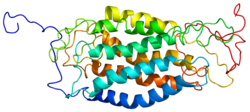 |
| CCR5 protein |
If we cannot come to a cure and biological conditions call for it, then perhaps the genetically meek truly will inherit the earth.
About the author


No comments:
Post a Comment